




Even though Apple is expected to introduce its next-generation smartphone lineup in a matter of weeks, the absence of official statements has done little to curtail an exhaustive stream of industry leaks.
Supply-chain reports and dummy model previews collectively paint a distinct picture of Apple’s strategy: the upcoming iPhone 18 Pro and iPhone 18 Pro Max will prioritize substantial engineering and silicon performance over radical cosmetic overhauls.
Rather than reinventing the exterior chassis, Cupertino appears focused on delivering internal milestones. From TSMC’s cutting-edge 2-nanometer processor node to mechanical camera apertures and unprecedented battery sizes, the upcoming flagship devices are shaping up to be among Apple’s most technically substantial updates in recent memory.
A Refined Palette: The 'Dark Cherry' Debut
Apple traditionally introduces a new flagship color option for its Pro series each year, and the iPhone 18 Pro lineup appears set to follow suit. Leaked dummy units and industrial supply-chain sources point toward a new hero colorway designated as Dark Cherry.
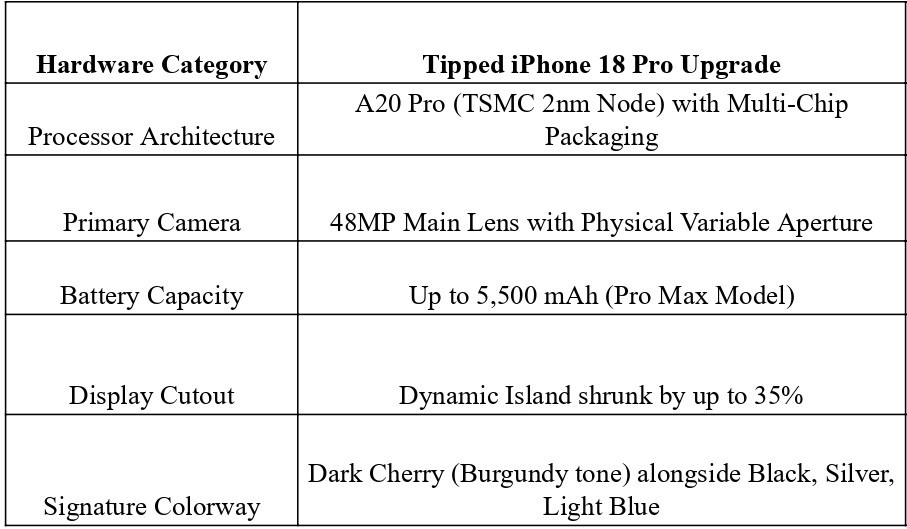
Unlike the vivid shades previously seen under Apple's Product(RED) banner, Dark Cherry is described as a deep, luxurious burgundy infused with subtle pink undertones, designed to complement the polished titanium frame. This signature shade will reportedly join a standard metallic palette comprising Black, Silver, and Light Blue. Aside from the prospective color additions, the external form factor remains virtually identical to its predecessor, maintaining flat edges and the familiar triple-lens camera module.
The A20 Pro Chip
The operational core of the new Pro lineup will be the prospective A20 Pro chipset, widely tipped to be manufactured using TSMC’s highly anticipated 2-nanometer (2nm) process node. The transition to a smaller transistor node naturally yields two critical advantages: heightened computing efficiency and reduced power consumption.
Reports indicate Apple may adopt an advanced wafer-level multi-chip module (WMCM) packaging technique. By positioning high-speed memory in closer proximity to the processor die, system latency is dramatically reduced enabling accelerated graphics processing and complex, on-device Apple Intelligence workloads without inflating power demands.
Camera Innovation Beyond Megapixels
While rumors suggest Apple will retain the existing 48-megapixel sensor resolution across its triple rear cameras, the primary camera system is expected to undergo a significant physical transformation. The standout hardware enhancement is a mechanical variable aperture system for the main lens.
Unlike fixed-aperture lenses common to most modern smartphones, a physical variable aperture allows the camera to dynamically adjust the amount of light reaching the sensor based on environmental conditions. This mechanical adjustment grants users finer control over depth of field, enabling natural background blurring for portraiture and significantly improved exposure handling in low-light environments. While variable apertures have occasionally appeared on select Android flagships, its integration into the iPhone ecosystem represents a major milestone for mobile photography.
Record Battery Capacities and Thermal Engineering
Battery longevity appears to be another primary focus for Apple this generation. Multiple supply-chain reports indicate that the iPhone 18 Pro Max will feature a battery capacity reaching up to 5,500 mAh marking it as the largest capacity ever installed in an iPhone. Regional variants are expected to range between 5,391 mAh and 5,567 mAh.
Accommodating this expanded battery cell will require structural compromises. Reports note that both Pro models will increase in thickness by approximately 0.25 mm, accompanied by a slight increase in total weight. To prevent thermal throttling during demanding workloads, such as high-frame-rate gaming or 4K video rendering Apple is also tipped to introduce a superior vapor chamber cooling architecture to maintain optimal operating temperatures.
Refined Display and Next-Gen Connectivity
Front-facing changes are subtle yet meaningful. Although screen dimensions will remain unchanged, tipsters report that several Face ID components have been successfully relocated beneath the display glass. This engineering feat is expected to shrink the Dynamic Island cutout by up to 35 percent, granting users additional usable screen space.
Furthermore, connectivity is set for an upgrade via Apple's second-generation custom C2 5G modem. The proprietary chip aims to enhance cellular throughput while significantly lowering power consumption compared to previous hardware iterations.
Launch Timeline and Market Expectations
Apple is expected to officially unveil the iPhone 18 Pro series during its traditional September keynote, with industry analysts eyeing September 8 or September 9 for the main presentation. Retail availability typically follows approximately ten days post-announcement.
While fringe reports suggest Apple could alter its strategy by launching Pro models alongside a flagship foldable while deferring standard models, such claims remain unconfirmed. However, price increases are widely anticipated across the industry, driven by the higher manufacturing yields associated with 2nm silicon wafers and specialized mechanical lens assemblies. Should these leaks prove accurate, the iPhone 18 Pro series may look familiar on the surface, but will deliver some of the most substantial internal hardware leaps in the device's history.
By Megha Singh | Published for Gadget Now, TOI









तपाईको प्रतिक्रिया दिनुहोस